



Being a student is your child’s childhood career.
Sounds silly, but attending school, completing assignments, writing tests, navigating social ups and downs and participating in school-based activities teaches our children how to be ready for adulthood. Meeting deadlines, navigating social situations and juggling multiple tasks and other people’s expectations—these are the skills that transfer to adult life. And much like with any job (including parenting!), learning to advocate for what you need to be successful needs to start when you are in school.
Students in Alberta are considered for an Alberta Education Code if they are navigating:
• A neurodevelopmental disorder
• A learning disorder or learning disability
• A medical condition
• Speech or language challenges
• Mental health challenges
This code allows access to accommodations and modifications. But what’s the difference?
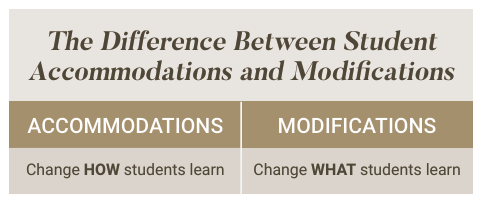
Accommodations change how a student learns.
Modifications change what a student learns.
Accommodations support students to “show what they know”
They help by changing the way students access information or demonstrate learning, but curriculum expectations are not altered.
Accommodations fall into four categories: presentation, response, setting and timing/scheduling.
Presentation and response can include assistive technology used both at home and at school. Text-to-speech software, scanning pens, calculators or specialized apps can be life changing for students. Some of my favorites include: Quizlet, Atlas and ReadTheory.
Teachers might change the format questions are presented in (oral, written, or digital), change how students respond (typing, speaking to a scribe, or recording), or provide notes so students can follow along instead of taking their own.
Setting might include writing a test in a separate, less distracting space or enabling a similar quiet space within the classroom.
Timing and scheduling might include allowing movement breaks, extended time on assignments or tests, short pauses to help students reset, or to manage stress and test anxiety.
Modifications help adjust the way students learn
They involve changes to what a student is expected to learn or demonstrate to better match their abilities and needs. Modifications are used when a child’s challenges make it difficult to meet grade-level expectations.
Schools can support students with modifications two main ways:
Simplified assignments: Reducing the complexity or length of tasks to match the student’s abilities. For example, changing the reading level of a novel to match the student’s current level, or using pass/no pass grading standard.
Adjusted learning outcomes: Setting personalized goals for the student that reflect their strengths and needs in one or more educational areas.

The Right Tools for the Job
Accommodations and modifications are designed to reduce barriers to learning and assessment. They address each child’s needs, whether they involve learning disorders, test anxiety, mental health challenges, or neurodevelopmental disorders. The result helps to support students so they can demonstrate their knowledge in a way that works best for them.
Just like in any career, success in your child’s childhood career means having the right tools to do the job well. When students learn to speak up for what they need, they unlock new possibilities and show us just how much they can achieve.