


Rebuilding Your Relationship with Work
Think about how you feel on Sunday night when you remember Monday is coming. That gut reaction says everything about your relationship with work.
The word “work” triggers something visceral in us. For some, it sparks excitement, energy, and fulfillment—a place where creativity flows and contributions matter. For others, it triggers anxiety, dread, or a heaviness that lingers before the day begins. These two reactions, hope and burden, are not mutually exclusive. Many of us experience both, shifting back and forth depending on circumstances and the meaning we attach to what we do.
Work is never just about tasks. It’s about the people we collaborate with, the ideas we struggle to bring to life, and the systems we’re part of. In its best form, work allows us to feel useful, engaged, and connected to something bigger than ourselves. Yet all too often, work becomes one of the greatest sources of stress. Long hours, competing demands, and ever-growing expectations chip away at our resilience. When we don’t deal with this stress, it grows into anxiety, damages our mental health, and leads us straight to burnout.
When Work Burns Us Out
Burnout is more than exhaustion—it’s a profound depletion that impacts not only productivity but also our sense of identity and meaning. Think of a forest after a fire: once vibrant and alive, now reduced to ash and emptiness. Many people describe their relationship with work in similar terms. They gave their all, poured in energy and passion, but now feel stripped of motivation, desire, and purpose. In this scorched state, even rest feels insufficient, and the idea of rebuilding seems overwhelming.
Faced with this depletion, some try to cope by simply pushing harder, convinced that forward momentum is the only way through. But no airplane can fly without fuel, and no human being can function indefinitely without replenishment. Sustained effort without renewal inevitably leads to collapse.
Finding Your Ikigai: A Map Back to Balance
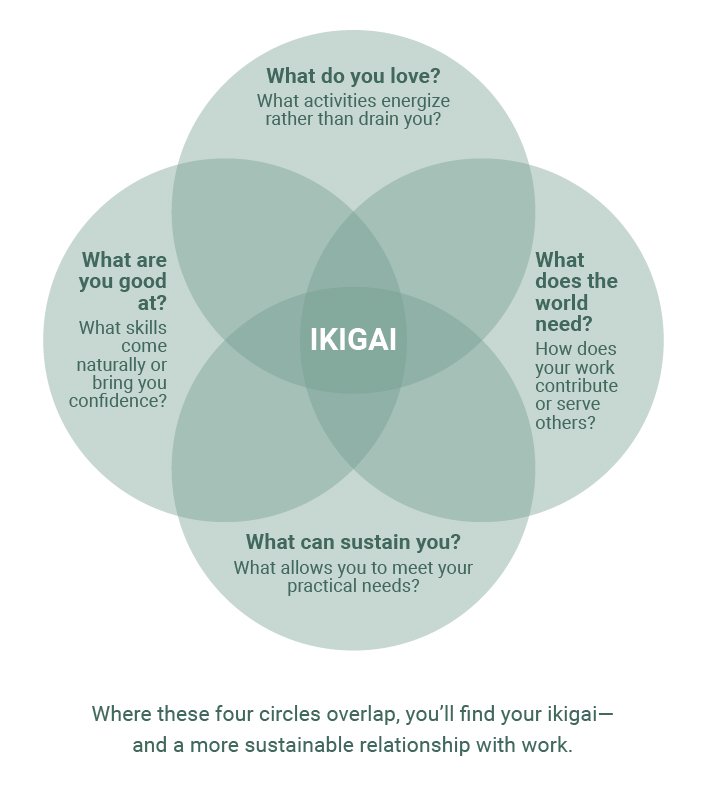
Ancient wisdom offers us a map back to balance. The Japanese concept of Ikigai—your “reason for being”—reminds us that meaningful work emerges at the intersection of four key dimensions. When these elements align, work becomes more than labor; it becomes life-giving. Research shows people with clear Ikigai live happier, more resilient lives, and even enjoy greater longevity.
Unfortunately, the modern workplace often conspires against this alignment. Economic uncertainty, layoffs, and relentless news cycles sap energy and narrow our perspective. In such an environment, it’s easy to forget that productivity is not the same as purpose. We may hit deadlines and check off boxes, yet feel increasingly detached from joy or meaning.
The Refueling Principle
This is why intentional restoration is essential. Every airplane requires refueling, and every human requires renewal. Renewal looks different for everyone: meaningful breaks, creative pursuits, supportive relationships, spiritual grounding, or physical movement. What matters most is recognizing that tending to our inner resources is not indulgence—it’s necessity. Without restoration, our capacity to think clearly, to innovate, and to connect with others diminishes.
As we consider the psychology of work, perhaps the challenge is not only in how we perform but also in how we sustain ourselves. Work will always carry demands, and stress will never vanish entirely. But if we can embrace practices of renewal, clarify our sense of Ikigai, and resist the temptation to measure our worth solely by output, we can begin to reshape the narrative.
Start with one question: When did you last feel truly energized by your work? That memory holds clues to your path forward.
The forest can flourish again.